
The production of nuclear energy is based on the reaction between neutrons and atomic nuclei in the fuel used.
When a uranium-235 nucleus absorbs a neutron and splits into two large energetic fragments, or fission products, it releases energy, on average 200 MeV (mega electron volts).
1 gram of uranium has 2.56*1021 an atomic nucleus with a fission energy of 2,56*10 21 *200= 5,12*1023 MeV = 8.2*1010 J = 0.95 MWday = 22.8 MWh of energy. Considering the efficiency of a steam turbine using 35%, 1 gram of U-235 can be converted into 8 MWh of electricity.
By comparison, to produce the same amount of electricity, 11.5 tonnes of oil shale must be burned and 5 tonnes of CO2 are emitted.
A good introduction to nuclear energy is a mini-course at the UT School of Science. From cosmic rays to the nuclear power plant.
SMRs
Internationally are defined as small modular reactors (VMRs) with an electrical output of less than 300MW.
The development of VMR is a development of the last 10 years, as large nuclear plants have become very expensive (over €5 billion) and construction is often overdue, with a number of problems and cost increases.
Building the reactor in modules and smaller allows for a lower total financial cost of the project, a more grid-compatible capacity, greater construction safety and a smaller reactor also allows for certain safety advantages.
The most important stage in bringing new reactor technology to power generation is obtaining a construction licence, or licensing. Among OECD countries, the United States is currently the furthest advanced in the construction licensing process. National Nuclear Safety Commission NuScale reactor.
Most VMR reactors, including Generation 4 reactors, are in the process of pre-licensing (Vendor Design Review). Canadian Nuclear Safety Commission by. Pre-licensing provides the reactor developer with the assurance that the technical and procedural solutions for their reactor meet the technical requirements set out by the regulator and that there are no fundamental obstacles to a further site-based construction licence procedure.
As a nuclear reactor is a complex engineering facility with an expected lifetime at high temperatures and/or pressures of decades, regulators require from the developers comprehensive data, based on experimental testing, on the performance and interactions of the different components (piping, valve, materials, fuels, etc.) and systems (primary thermal contour; emergency shutdown system, etc.) to ensure beyond doubt the long-term design performance of these systems and the safety of the overall system under all possible scenarios.
Nuclear regulation
Given the high energy concentration of nuclear energy, which requires a high level of competence and procedures, and which entails both potential military applications and risks in energy production, nuclear energy is highly regulated internationally. International Atomic Energy Agency and international conventions.
One of the Treaties on which the European Union is founded is Treaty establishing the European Atomic Energy Community and nuclear energy is covered by two main directives:
- Directive 2009/71/Euratomestablishing a Community framework for the nuclear safety of nuclear installations
- Directive 2011/70/Euratomestablishing a Community framework for the responsible and safe management of spent fuel and radioactive waste.
Nuclear energy is a low-carbon and manageable source of electricity that ensures a high level of energy security for the region and provides 53% of carbon-free electricity in the European Union.
The EU has 128 nuclear reactors (119 GWe), which account for about 25% of the total electricity produced in the EU. Nuclear power is in operation in 14 EU Member States (Belgium, Bulgaria, the Czech Republic, Finland, France, Germany, Hungary, Bulgaria, the Netherlands, Romania, Slovakia, Slovenia, Spain, Sweden and the United Kingdom).
Half of the EU's nuclear electricity is produced in just one country - France. The 53 reactors operating in three non-EU countries (Russia, Ukraine and Switzerland) account for about 17% of total electricity in the rest of Europe. (Source: WNA)
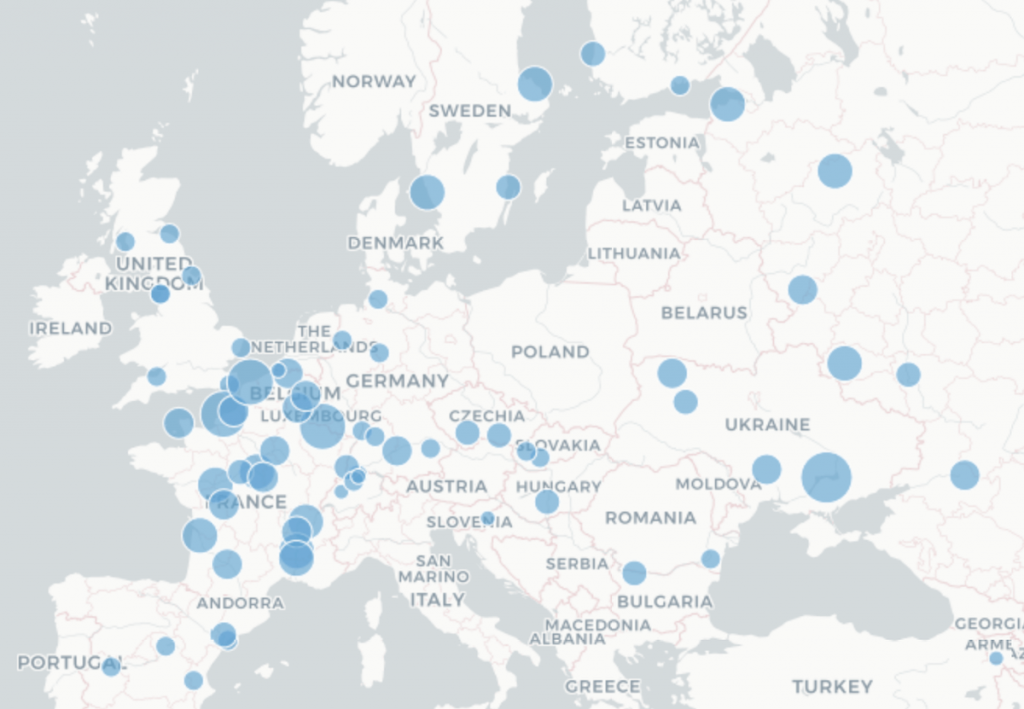
Figure: Nuclear power plants operating in Europe (2016) Source: (LINK)
The closest operating nuclear power plants to Estonia are the 5 reactors at the Leningrad plant in Russia (70km), the 2 reactors at Loviisa in Finland (100km), the 2 reactors at the Olkiluoto plant (250km), the 3 reactors at the Forsmark plant (280km) and the 1 reactor at the Oskarshamn plant (330 km).
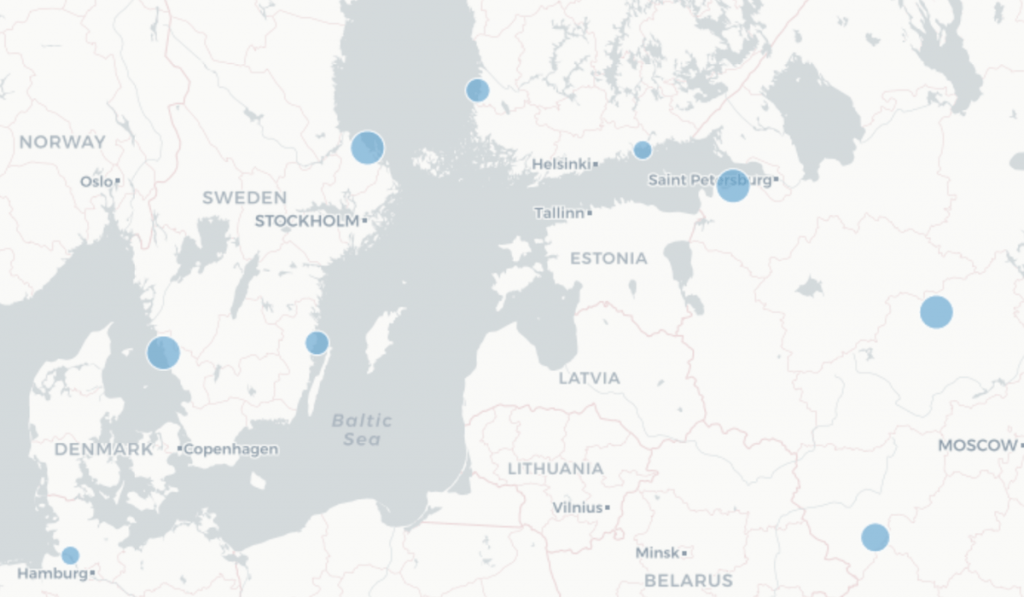
Figure: In the vicinity of Estonia, nuclear power plants are operating in Finland, Sweden and Russia. Source.LINK)