
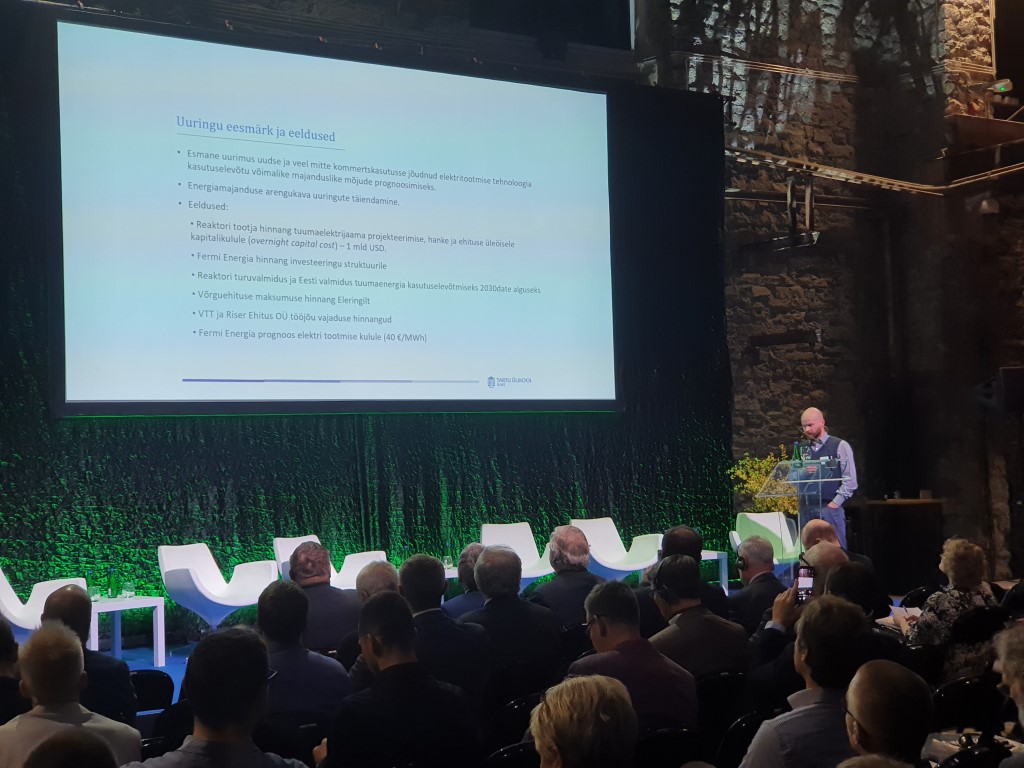
A pre-cost-benefit study of the economic impact of a small modular reactor carried out by the Centre for Applied Social Science Research (RAKE) at the University of Tartu found that the construction of a new generation of modular reactors and the generation of electricity from them could have a positive economic impact on both the country and the area around a potential power plant.
The construction of a power plant with one reactor module (at a total cost of around €1 billion) is estimated to generate more than €300 million in goods and services from Estonian companies and €100 million in direct tax revenues for the state. The production of electricity in a single-module nuclear power plant would also avoid annual electricity imports of €130-150 million.
The feasibility study shows that a new generation of small modular reactors would also have a significant positive impact on the areas surrounding the power plant and the local municipality where the reactor would be located, in terms of an increase in the number of highly-paid municipal residents, an increase in the consumption of goods and services purchased from local businesses, and a potential subsidy to the municipality. People would also be able to work in the plant's training and visitor centre.
As a more indirect impact on the area around the potential power plant, the study noted that the plant would allow new investment and high value-added industry to be attracted to the nearby area, as the Electricity Market Act would allow these companies to have free direct access to electricity from the grid, which would give a clear competitive advantage to high electricity-consuming industry.
"A nuclear power plant is not built overnight, but requires a period of preparation of more than a decade or more. At Fermi Energy, we have made it a clear goal to carry out extensive research and talk to people all over Estonia before moving ahead with this project at a faster pace. I am pleased to say that the messages of the economic prefeasibility study were encouraging, but in this case we need to understand that the economy is only one part of the big picture," said Kalev Kallemets, Chairman of the Board of Fermi Energia.
Siim Espenberg, Head of the Centre for Applied Social Science Research at the University of Tartu: "Economic impact studies should be the be-all and end-all for such projects, as they affect a very large part of society. We at the university have developed the capacity to carry out such analyses and we are pleased that the Fermi Energia team is taking the preparation of the project very seriously, looking at the different aspects that come with such large-scale projects."
The study was carried out by the Centre for Applied Social Research (RAKE) at the University of Tartu, and was co-authored by Hans Hõrak, Mustafa Hakan Eratalay, Kevin Kuriakose and Anastasiia Pustovalova.
Fermi Energia's goal is to bring Estonia's energy production into the 21st century by developing a modern, small nuclear power plant that will ensure Estonia's security of electricity supply in all weather conditions, affordable prices for electricity consumers, and meet the country's climate targets.
Fermi Energia was founded by Estonian nuclear energy and physics PhDs Marti Jeltsov, Merja Pukari, Kaspar Kööp, Henri Ormus and Mait Müntel and energy economics PhDs Sandor Liive and Kalev Kallemets.