
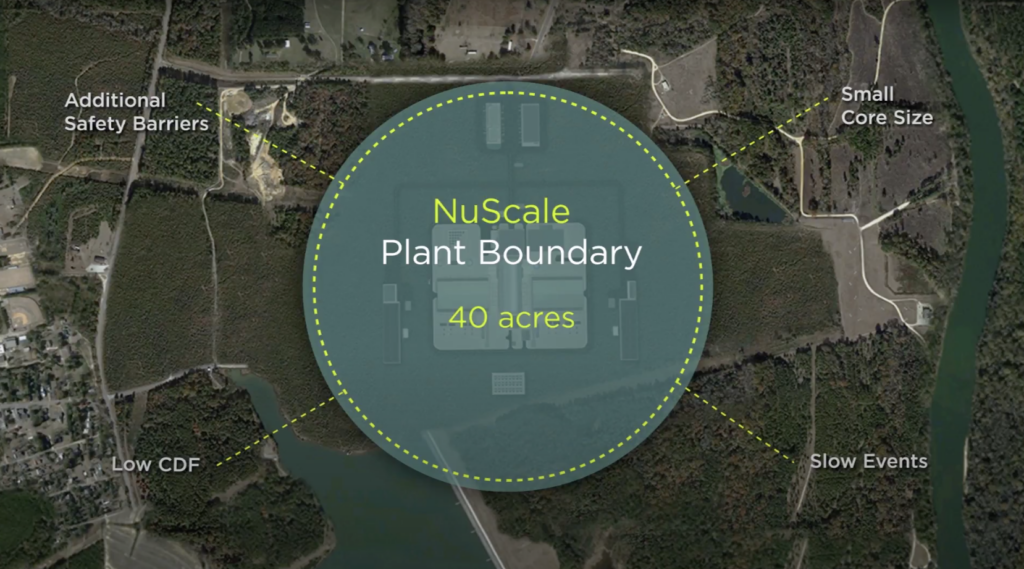
Under a cooperation agreement signed today, 11 May, the Institute of Chemical and Biophysical Physics (KBFI) will investigate how large an emergency planning area would be needed for a nuclear power plant based on small reactor technologies selected by Fermi Energia.
Under the cooperation agreement between Fermi Energy and KBFI, a working group will be set up within the Institute's High Energy and Computational Physics Laboratory (KEAL) to assess the potential for radiation to propagate outside the reactor for four reactor types, and to calculate the size of the emergency planning area required for each reactor type, based on international standards.
"Safety is an essential prerequisite for nuclear energy, and the purpose of the study of the emergency planning area is to understand in depth and computationally, in Estonian, how small reactors of the 21st century will prevent radiation from spreading outside the plant's territory," explained Kalev Kallemets, CEO of Fermi Energia. "It is not enough to rely on the claims of the developers, we also need to check and verify the safety analyses of international regulators. Only safe nuclear energy can be beneficial for the whole of Estonia, ensuring carbon neutral energy supply in all weathers," Kallemets added.
According to Urmas Nagel, Director of the KBFI, the study will be completed under the guidance of Martti Raidal, a top Estonian physicist, in cooperation with top Estonian and international experts and will be published in January 2021. "In view of the need to develop nuclear expertise in Estonia, KBFI has started research on reactor physics and nuclear safety in the High Energy Physics Laboratory. The agreement with Fermi Energy demonstrates the interest of the Estonian business sector in reducing climate warming and carbon emissions," said Nagel.
KBFI is Estonia's representative at CERN, the European Centre for Nuclear Research.
Fermi Energia is a company exploring the possibility of building a new generation of small modular reactor power plants in Estonia to meet electricity security and climate objectives.