
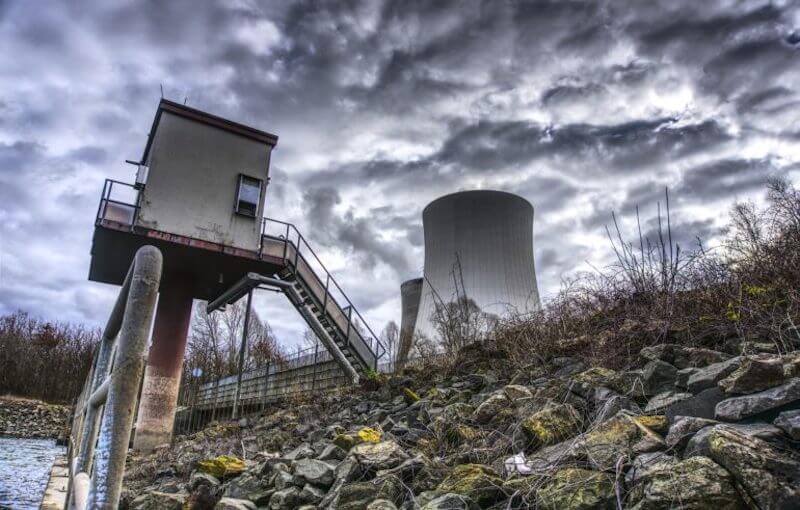
After the Fukushima nuclear power plant accident in 2011 irradiated a large part of the surrounding area, the public stopped talking about building a nuclear power plant in Estonia, as if by cutting it off. However, ahead of the completion of the so-called fourth-generation reactor, the issue is back on the agenda in Estonia. And there are more than expected many thinkers in Estonia.
A couple of weeks ago, a nuclear reactor construction company visited Estonia. British and Canada company Moltex Energy Representative Simon Newton. He said that Estonia would be wise to replace the production of energy from oil shale with a nuclear reactor at some point.
Clean energy technology company coming here next week Terrestrial Energy members of the Board of Directors to work with the company to Fermi Energia discussing the possibilities for cooperation in carrying out a cost-benefit analysis of the siting of a nuclear reactor in Estonia.
Ministry of Economic Affairs and Communications we can confirm that there is currently an intense debate on the construction of a nuclear power plant in Estonia.
"There is certainly no reason to rule out nuclear energy in Estonia in the future," says the Deputy Secretary of State for Energy at the Ministry of Economic Affairs and Communications. Timo Tatar Genius.
Oil shale is good for
Oil shale energy will one day die out due to high pollution and rising costs, and green energy will not last a whole year with today's technologies.
"In Estonia, we have to start asking ourselves pretty soon what the next source of electricity will be," says Estonian physicist and science populariser. Andi Hektor.
He said we should keep our eyes open for fourth-generation reactors. However, we cannot immediately order a reactor because there is no legislation to build one.
"Not that Estonia should necessarily do this, but we should create the legislative preparedness. Maybe we want to do this kind of thing," says Hektor.
"When in 2025 the first reactor comes on line and we in Estonia say we would like to do that, we should start quietly today," says Hektor.
Vice-Chancellor Tatar adds that the issue is important and should be addressed. All the more so as nuclear technology is one of the few known technologies that can also help to reduce the world's CO2 balance on the energy side.
But let's start from the beginning. What is this fourth-generation nuclear reactor?
Estonian physicist and science promoter Andi Hektor tells Geenius that there is no one specific fourth-generation nuclear reactor, but there are several new technologies.
"What fourth generation is not so well defined. The fourth generation is everything that comes after the third, or the third generation. 3+ generation," says Hector. If you are interested, the reactor currently under construction in Finland is the so-called. 3+ generation nuclear reactor.
Fourth generation reactors are characterised by the fact that they are. with fast neutrons reactors. This means that the fuel consumed in the reactor is not as radioactive as in previous generations.
"If you take the scraps out of the third generation reactor, they would have to be kept underground for about... 50 000 years, after which they become more or less safe. If you take out the nuclear waste from the fourth reactor, the one with fast neutrons, it is dangerous about 500 years," says Hector.
Old nuclear waste for heating the new station
In addition, since 70. years nuclear revolution foresees that a newer generation reactor will be able to outperform an older generation. use leftover nuclear waste as fuel and today it is. The nuclear waste left behind by the third generation reactors, which would otherwise have to lie underground for 50 000 years, can now be put into a fourth generation reactor where it will be used as fuel.
"When you take the scraps out of a third-generation reactor, you have to cool them for about 20 years because they are hot," says Hektor.
Waste from a third-generation reactor cannot be placed in glass or concrete, because the heat will cause the residue to leach out at some point. However, Generation IV waste can be stored as soon as it is removed from the reactor, for example by melting it into glass.
Glass blocks can be placed at the bottom of the sea, for example, and in 500 years' time they can be retrieved, as the waste is much cooler to begin with and does not melt out of its own envelope.
It is already familiar in military engineering
Fourth generation reactors are not yet available on the market. However, this type of reactor has been in use in the military for some time, precisely submarines, where energy supply is a problem, but military technology is expensive and not sold directly to private companies.
Idea for example based on liquid salt for the construction of the fourth generation reactor came from the From America, which wanted to power its long-range bombers with a nuclear reactor instead of refuelling in the air. A prototype of the reactor was completed, but the project never reached widespread use.
How is safety guaranteed?
At the beginning of this decade, the development of fourth-generation reactors was mainly taken over by private companies, which in this world are like start-ups. One of the best known of these is Moltex, which will create a reactor that runs on liquid salt, which is safer and cheaper than previous fuels.
In the past, when reactors were being developed by the big powers, there was more of a pre-accident mindset from the 1980s, where safety was not such a high priority. Today, with private development companies, safety is one of the main selling points.
Third generation reactors are with high pressure reactors, where the piston-shaped reactor is enclosed in a steel casing, which in turn is pressurised to a high pressure of around 500 atmospheres. When a hole is drilled into such a machine, radioactive water gushes out, the reaction becomes highly reactive, the interior melts away and the surroundings are irradiated.
"But the new reactors are molten salt reactors, they are not pressurised, nothing wants to come out of them and they work on the natural effect that if the reactor gets too hot inside, the salt expands, the reaction stops and it shuts itself down," says Hektor.
Moltex wants in 2025 to complete its first commercial reactor, it is also already one of the first in the Canada commissioned by a major energy producer.
Fourth-generation reactors can also be built with different capacities. They can range from small reactors of 40 megawatts, which could, for example, power a space station or spacecraft, to national reactors of 500 megawatts or more.
Fourth-generation reactor in Estonia makes more sense than third-generation reactor would have been
"A typical third-generation reactor is around 1500 megawatts. Estonia could have one, or maybe two, of these reactors, and then our market would be flooded with electricity," says Hektor.
Another disadvantage of the third generation is that they need to be switched off every few years and serviced for a few weeks. Then Estonia would be back to being a power shortage. The fourth-generation reactor being developed by Moltex will have a capacity of about 500 megawatts.
Timo Tatar from the Ministry of Economic Affairs and Communications also believes that it is better to do things slowly and carefully than to get things ready too early and build a reactor immediately.
With new technologies, teething troubles will initially appear, and it is reasonable that if such a reactor is ever to be built in Estonia, these risks will have already been identified elsewhere and proactively corrected in the design. However, if the issue is to become serious, the state needs to create a legal regime that would establish rules that the developer must follow. This will give reassurance to society that all the most stringent safety requirements will be followed.
For example, a nuclear safety agency should be set up. "At the moment, this is still a bit premature and a long way off," says Tatar. In addition to the legislative preparation, which is a long process in itself, Tatar believes that we should not forget to prepare the public and society for debating such issues.
"This is a project with a potential lifespan of... 60 to 100 years. In order to be able to invest in it, there must be certainty that there will not be a referendum at the next elections and a decision to close the stations. You don't have to look far for such examples."
A nuclear reactor by 2030?
Recently, Estonian company Fermi Energia started a partnership with Moltex Energy to prepare a feasibility study for Estonia on their fourth generation reactor.
"The outcome of this analysis will be whether a small modular reactor is a suitable and adequate technological solution for Estonia's energy security and decarbonisation objectives," says. Kalev Kallemets, one of the shareholders of Fermi Energia, to Geenie.
Whether 2030 we will be able to plug into the reactor and happily go nuclear, we don't yet know, because it is too early to make such promises, but the need for an alternative is already starting to emerge today.
Eesti Energia announced that 600 MW of shale-based electricity generation capacity will be reduced already this year, and another 800 MW by 2030 at the latest. This will leave only 700 MW of oil shale power generation capacity in Estonia.
In 2025, the entire Baltic region will lose electricity connections Russia and With Belarus. Thus, the energy economy in and around Estonia is in a constant state of flux, as also, for example. Finland is in the process of closing its coal plants, and is also closing its Sweden a couple of parents, and Germany all its nuclear plants.
"The whole Europe a lot of controllable capacity is falling out of production," Kallemets says. This leaves non-controllable capacity, such as wind power. But wind is not controllable, so if there is no wind tomorrow, electricity production will be lower. All of this makes one wonder what to do in Estonia, and Fermi Energia has also come to the conclusion that a nuclear reactor is one of the possible solutions.
According to Kallemetsa, the following will be completed USAsand Canada About 2028 several different reactor models by 2020. By that time, he says, Estonia should be ready to assess and analyse which option would be the most suitable for us, and to develop the capacity to build the best reactor and generate electricity following the appropriate licensing procedure.