
The world is heating up. Estonia too.
Sea levels are rising. Summers are too hot. No snow in winter. Climate vagrants tend to head north. Forest fires increase. More floods. Storms are stronger. Droughts become longer. Permafrost melts.
Nuclear energy helps to slow down the heating.
Scientists are convinced that climate change is man-made, and that we are the main culprits. By burning fossil fuels, we have added so many greenhouse gases to the atmosphere, carbon dioxide being the main culprit, that the greenhouse effect has arrived. We cannot stop global warming overnight, but we can slow down the changes and prevent further warming.
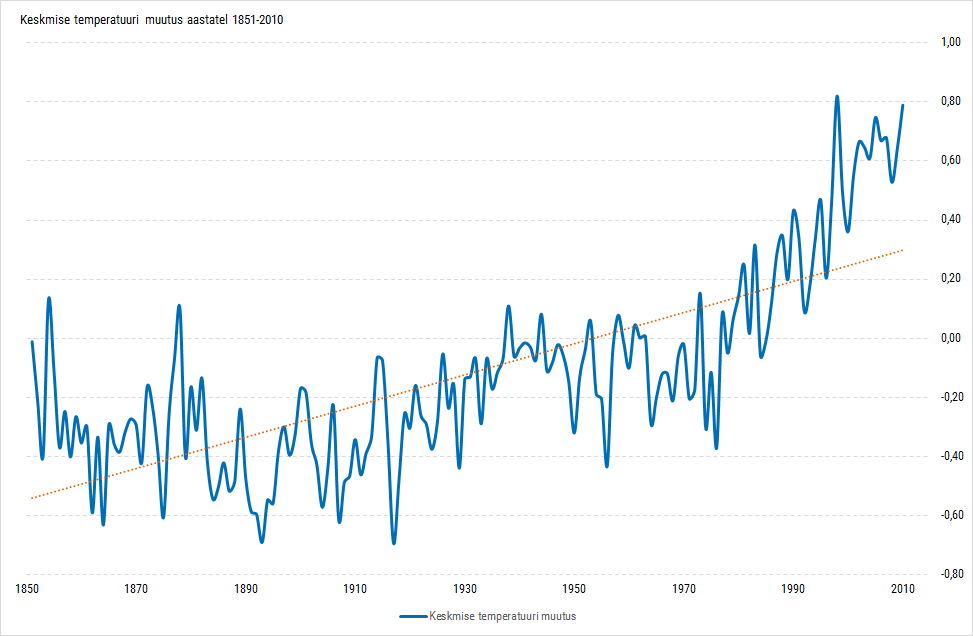
Our planet is getting warmer every year. You can see this warming in the beautiful striped image above - each colour stripe represents a year in the past, with the colour showing the average temperature for that year - the redder the warmer. Here's another graph:
Extract from the Ministry of Environment climate change leaflet:
It is clear from all past climate change research that there is a link between CO2 concentration and temperature change. Most scientists also believe that humans are playing a far greater role in today's unprecedented rate of climate change than any natural causes. Indeed, the main driver of change is the release of emissions into the atmosphere - in addition to CO2, methane (CH4), nitrous oxide (N2O) and fluorinated gases (F-gases) also have a significant impact. Together, all climate-changing gases are called greenhouse gases. The effect of greenhouse gases on the atmosphere is in turn called the greenhouse effect.
When talking about climate change, the emphasis is mostly on the rise in average atmospheric temperatures. There are a wide range of other consequences associated with warming, most of which are detrimental to people and nature.
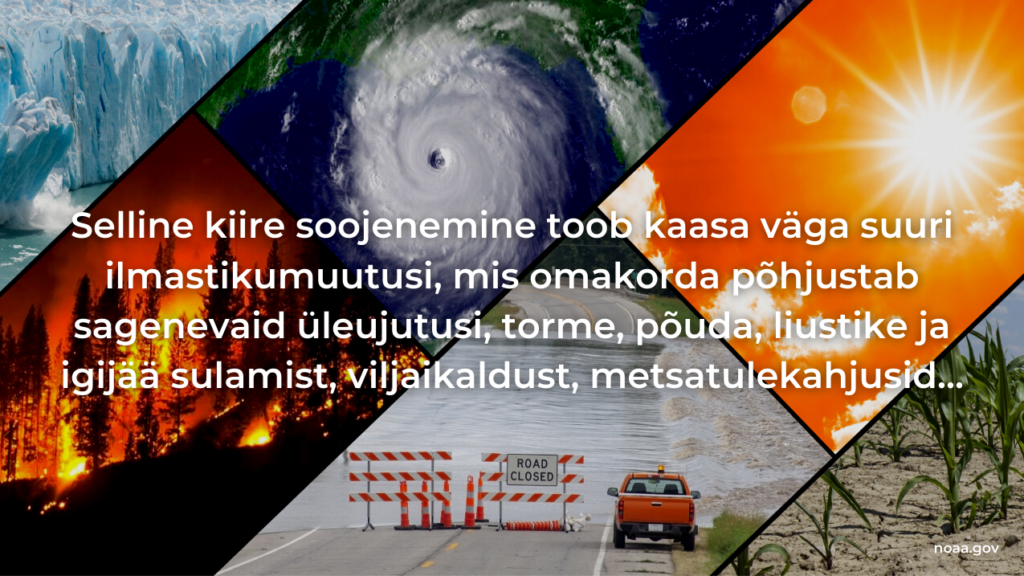
Excess CO2 in the atmosphere heats the climate. Carbon dioxide has always been present in the Earth's atmosphere, but the burning of fossil fuels has multiplied the amount of CO2 in the atmosphere.
We need to stop burning to curb the climate crisis.
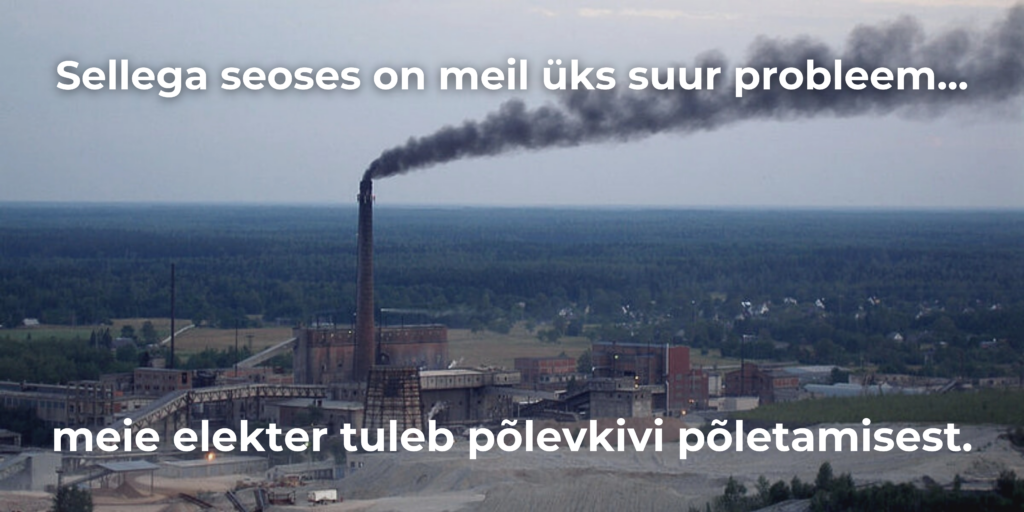
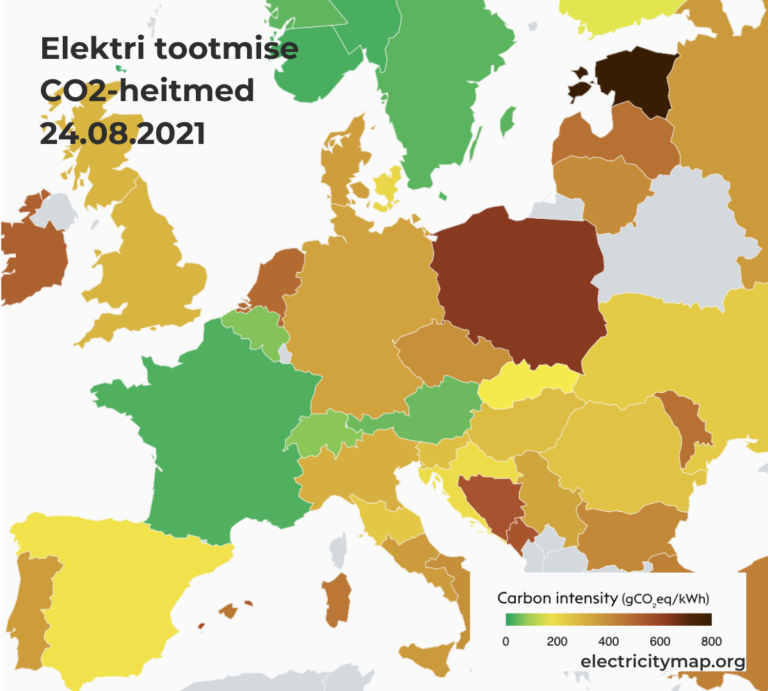
Not only that, but most of our cars run on petrol, diesel or fossil gas, and charging an electric car with shale electricity is not quite the right solution either, because burning shale produces an extraordinary amount of carbon dioxide. We are leading the way in Europe and the world in terms of carbon emissions from our electricity generation:
If we can't do away with electricity, space heating and driving, how can we produce energy in a climate-friendly way?
There is a solution to the climate crisis!
Jaak Laineste, climate activist
Extracted from climate activist.ee from the page, used with the author's permission:
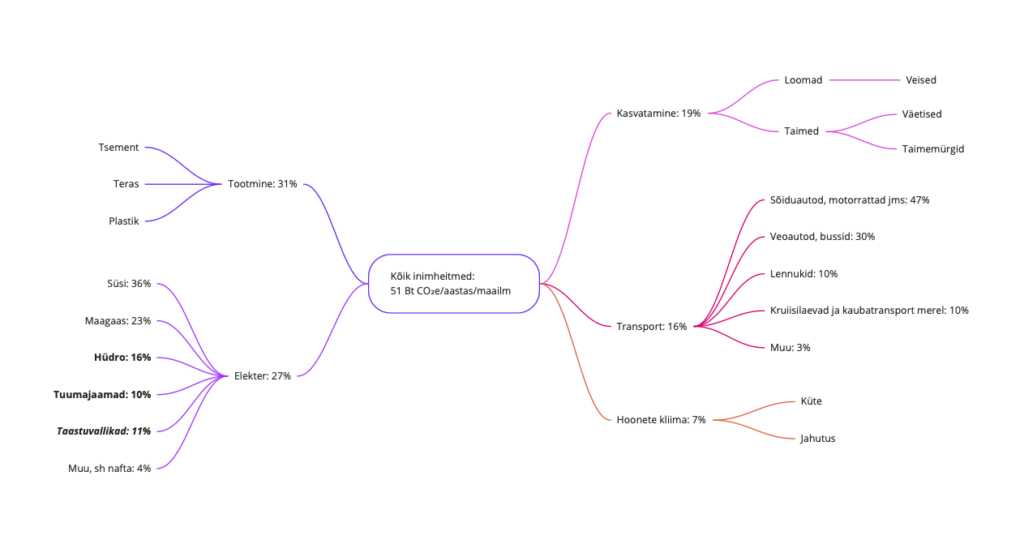
Let's first look at where exactly the pollution comes from. Based on this book we get the global picture below. Estonia has historically had a much higher pollution (footprint) from electricity production, over 80%, and we have little steel and plastic production. But if we neutralise electricity production, we will have a somewhat similar picture:
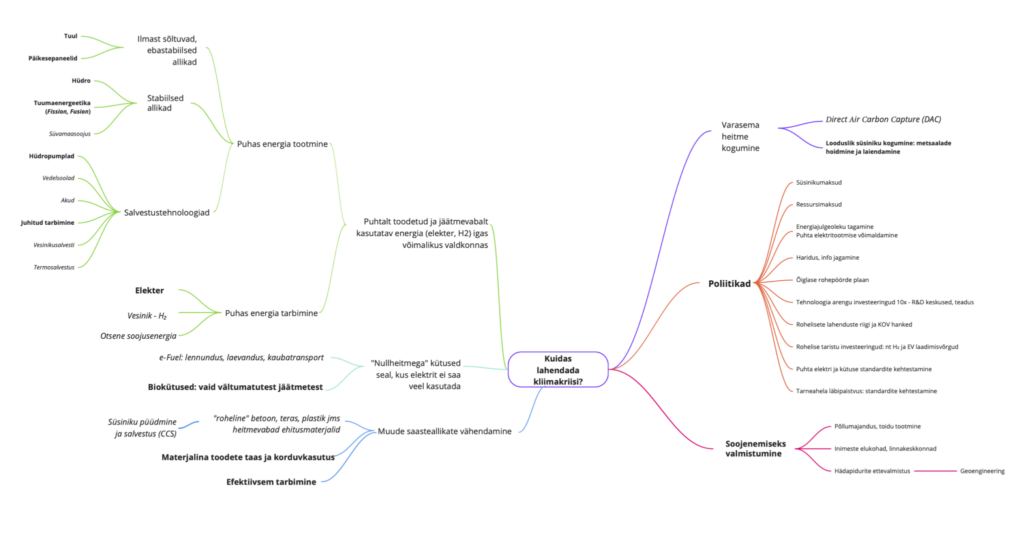
The figure below shows the main solutions to the climate change problem in a cloud of ideas. Most of the key words should be fairly straightforward to understand, and there are more detailed articles on several of them here on the blog. In bold are already today existing technical solutions or solution areas - these should be addressed as a matter of immediate priority. Some of these are already actively in the pipeline, but some (such as nuclear) are so politically sensitive that they do not get the attention they deserve as part of a solution. The letter is technologies that still need significant development, even breakthroughs.
We need energy, but we can't keep on burning. Fortunately, energy can be produced without carbon emissions. Wind turbines and solar panels on windy days, nuclear power at other times. We need them all.
Divesting from fossil fuels will require replacing it with very low CO2 emission energy production, even if energy efficiency can be significantly improved. Wind, solar and biomass are currently the most popular alternatives. Wind and solar are excellent ways of generating energy, but they face the problem of weather dependency and production variability, and the consequent need for energy storage or the addition of managed generation units.
In addition, the low energy density compared to fossil fuels and nuclear energy sets its own limits, because if we want to leave space for nature, we cannot increase the land needed for energy production infinitely. The growing use of biomass energy is a threat to biodiversity and is not really emission-free: its use must be kept to levels that are ecologically sustainable.Atte Harjanne and Tea Törmänen, Finnish Greens
Nuclear energy is CO2-free!
Like renewables, nuclear power does not emit carbon dioxide, and like shale plants, electricity can be generated when it is needed.
Excerpt from an article published in EPL on 07.08.2021 "Estonia could become a nuclear pioneer", used with the authors' permission:
Nuclear energy is Europe's largest source of low-carbon electricity and we will continue to need it. Nuclear Energy have the advantages of high energy and power density, stable production and a small environmental footprint. In addition, nuclear power can produce both electricity and heat.
In Finland, interest in small modular reactors in particular has been growing in recent years, among politicians, energy companies and researchers alike. Nuclear legislation is being updated, research and study projects are underway and a majority in the newly elected Helsinki City Council is ready to approve a small nuclear power plant in Helsinki.
Nuclear power would also be welcome on the southern shore of the Gulf of Finland. The current burning of oil shale is unsustainable for the climate, and the price of electricity is getting quite expensive due to the high CO2 price. In a world of tightening standards and obligations, polluting energy production is also not very attractive for investment. If Estonia wants to make the transition to climate- and nature-friendly electricity and heat production without importing significant amounts of electricity, there are not many options left. Nuclear energy fits perfectly into this equation, and it is no wonder that interest in nuclear energy and small modular reactors is also growing in Estonia.
So:
What can be done to stop climate warming?
If you can get to work and the shops without a car, don't buy a car, take the bus, cycle or walk. If you already have a car, just leave it at home some days.
Don't order things online that you don't really need. Buying things is very easy these days, but try to limit yourself to the things you really need.
If you need a car, buy one that is as economical as possible, preferably an electric car. Electric vehicles are being added to the model range of different car manufacturers every year, and the second-hand market is also growing rapidly. If you can't find one today, take a look in a few months or a year - the choice will have improved considerably.
Meat production has a high environmental footprint. If you don't want to stop eating meat altogether, make a conscious choice to replace it with something healthier for some meals. You'll also live healthier for longer.
When heating your home in winter, make sure the windows are well insulated and pull on a jumper before turning up the thermostat to an extra degree of heat. Energy is going to get even more expensive in the near future, so every degree you save on heating is reflected in your wallet.
Everything we consume uses energy. The less we consume, the less we pollute. But you can't do without consuming. That's why we need all forms of CO2-free energy, both weather-dependent and managed.
The addition of wind and solar power to partially replace fossil fuels is good, but for our electricity generation to become truly CO2-free, we also need managed CO2-free generation to support renewables. In Estonia, this can realistically only be nuclear.