
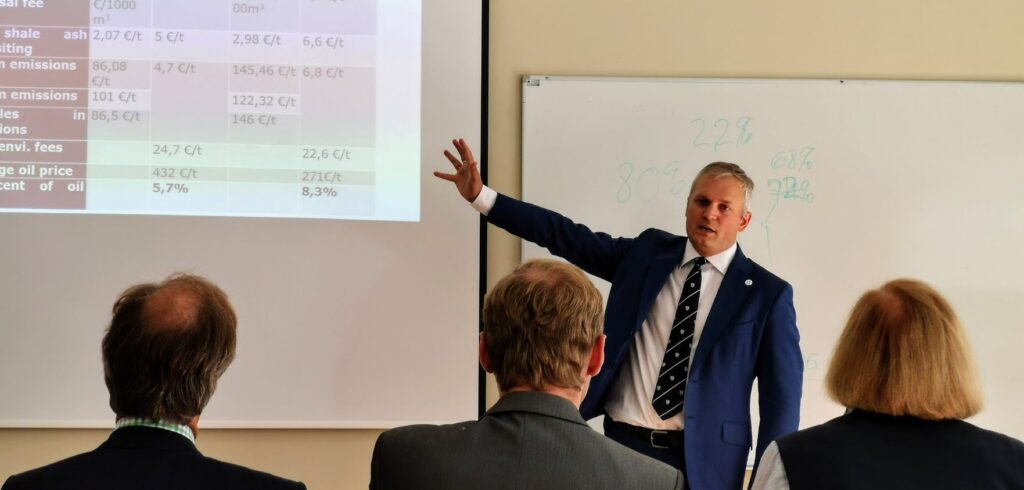
Kalev Kallemets, Chairman of the Board of Fermi Energy, met with Daniel Brady, Deputy Director of the Nuclear Energy Division of the Canadian Department of Natural Resources, and Marcel de Vos, Chief Licensing Officer of the Canadian Nuclear Licensing Commission for new reactors, where he got an overview of the Canadian nuclear regulation and control mechanisms, which could serve as a model for the construction of a new generation modular reactor in Estonia.
Marcel de Vos, a senior official in the licensing procedure for new reactors, met with Kalev Kallemets, Fermi Energia's CEO, from the Canadian Nuclear Safety Commission, which has a staff of nearly 600, and gave a comprehensive presentation on Canadian regulation. Canada's nuclear regulatory framework is interesting because it is based on flexibility and a high level of professionalism among officials, which is why almost all the new generation modular reactors in the Western world are applying for licensing in Canada. This is supported by a clear willingness on the part of Canadian energy companies to build new reactors and export them.
"In learning about the Canadian model, it became clear that energy companies need to develop their own in-depth technical understanding of the new generation reactors with the technology developer early on, because ultimately the energy company is the applicant for the construction permit and is responsible for safety," said Kalev Kallemets, head of Fermi Energia. "While Estonia can take the construction licence granted in Canada as the basis for its own procedure, the future Estonian regulator must have credible technical competence to understand whether the licence applicant is competent enough to operate the reactor safely. Therefore, it is justified to develop the relevant competences at a very early stage."
Kallemets also met with Daniel Brady, Deputy Director of the Nuclear Energy Division of the Canadian Department of Natural Resources, to whom he outlined the strong market demand for carbon-free electricity resulting from the European Union's 2050 climate neutrality target. Mr Brady, in turn, outlined Canada's coal power phase-out target for 2030 and the plans of major power companies to build small modular reactors of 200-300MW capacity in several provinces between 2026 and 2028.
Canada is very open to cooperation with new nuclear countries and companies, building on its experience of exporting CANDU reactors to Romania, South Korea, Argentina and India. The Canadian government, through its various funds, is providing substantial support for the development of new technology with a view to exporting nuclear reactors around the world in order to reduce humanity's carbon footprint.
Fermi Energia's goal is to bring Estonia's energy production into the 21st century by developing a modern, small nuclear power plant that will ensure Estonia's security of electricity supply in all weather conditions, affordable prices for electricity consumers, and meet the country's climate targets.
Fermi Energia was founded by Estonian nuclear energy and physics PhDs Mati Jeltsov, Kaspar Kööp, Henri Ormus and Mait Müntel and energy economics PhDs Sandor Liive and Kalev Kallemets. To date, €280 000 has been invested in the company to carry out the feasibility study.