
Consideration of a small modular reactor is supported by 58% of the population
The results of a recent Kantar Emor survey show that 58% of those polled support or tend to support the use of a small modular reactor to secure Estonia's electricity supply. The results of the previous poll, conducted in February, showed the same result.
"Support for research into the development of nuclear energy in Estonia is consistently high, and shows that Estonian citizens attach importance to the production of carbon-neutral electricity in all weathers. It is good to see that some people still know, for example, that nuclear energy has no CO2 emissions that cause global warming," said Kalev Kallemets, Member of the Board of Fermi Energia, commenting on the survey results.
The split between strong and softer views has changed somewhat, with 27% strongly supportive and 31% rather supportive in February, compared to 25% and 33% respectively in September. There is a similar shift in the number of non-supporters - in February there were 14% strong opponents and 16% 'rather no', while in September there was a shift towards more uncertain opinions - 13% gave a clear 'no' and 17% 'rather no'.
At the same time, 45% of respondents favoured the development of a new generation of small nuclear power plants in the light of a reduction in shale electricity production, ahead of natural gas (17%), woodchips (13%) and shale electricity as a by-product of oil production (13%). The development of wind and solar power for security of supply was considered necessary by 65% and 64% respectively.
There was a clear difference in support between the sexes - while women's support for a new generation of small nuclear power plants to ensure security of supply was 28%, with a strong preference for solar power (65%), men felt that a nuclear power plant (64%) was even more necessary than solar power (63%).
In this question, people were also asked to rate their awareness of the different ways of generating electricity - 6% (12% men and 1% women) considered themselves "very aware", 36% (53% males and 21% females) were 'rather aware', 46% (30% males and 60% females) were 'rather unaware' and 12% (5% males and 18% females) were 'not aware at all'.
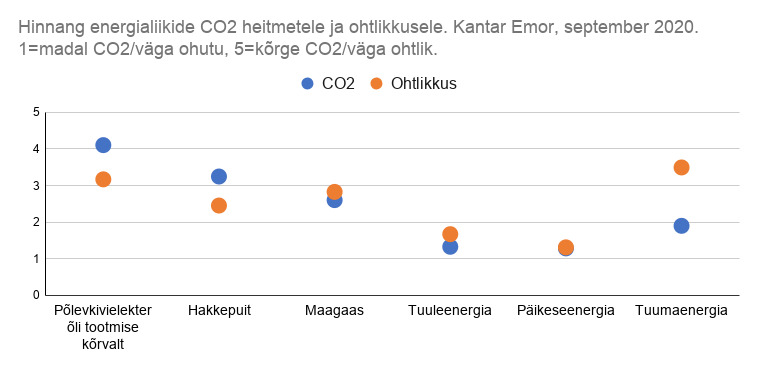
Respondents who identified themselves as "very aware" and "somewhat aware" were also asked about the magnitude and safety of CO2 emissions from different electricity generation options. For example, in terms of CO2 emissions, there is already some awareness that nuclear plants do not emit CO2, or at least that emissions are considered to be lower than, for example, natural gas.
"Myths about nuclear energy are disappearing," said Kalev Kallemets. "In reality, nuclear power is one of the cleanest of all forms of electricity generation, on a par with renewables - also in terms of safety. We are committed to reaching out to every school in Estonia to dispel the myths about nuclear power - factually and scientifically," Kallemets explained.