
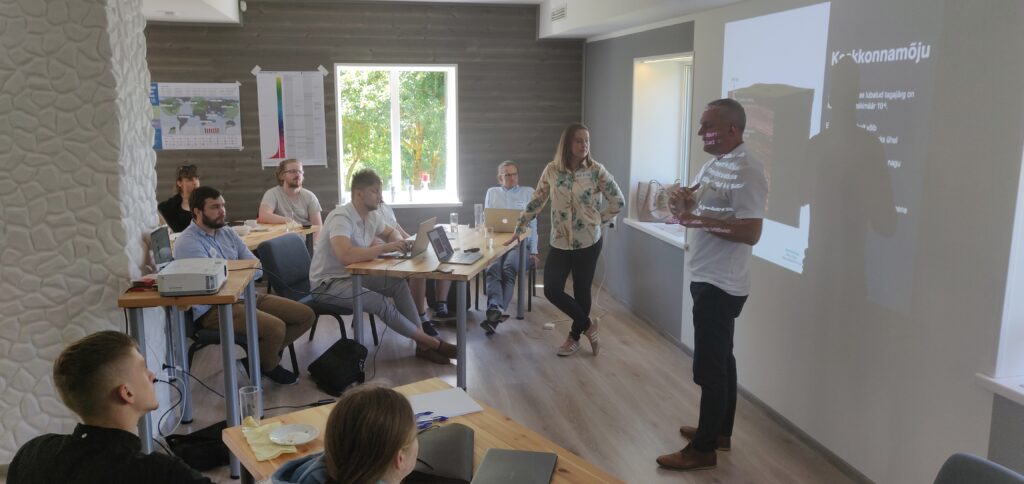
Fermi Energia organised the 7.-8. Estonia's first modern nuclear summer school "Fermion" was held in London on 7 and 7 August, inviting high school and undergraduate students from a wide range of disciplines. The only prerequisite was an interest in nuclear energy.
"Within the short registration period, almost 80 young Estonian nuclear enthusiasts announced their wish to participate, which shows that we need to organise such events regularly in the future. We were able to accept just over 20 applicants for the first time, but we will certainly keep all applicants in mind when planning future training events," said Kalev Kallemets, CEO of Fermi Energia.
In addition to Fermi Energia's nuclear experts, lecturers from elsewhere also spoke at the summer school - physicist and KBFI Deputy Director Mario Kadastik spoke about new age energy in Estonia, radiation protection researcher Siiri Suursoo from the University of Tartu Institute of Physics explained radiation and related myths, and expert Rodrigo de Oliveira from the Swiss Paul Scherrer Institute's Laboratory for Scientific Computing and Modelling introduced reactor simulation for the more serious nuclear enthusiasts. On the second day of the summer school, materials scientist Rainer Küngas spoke about hydrogen as a possible fuel of the future, and TalTech energy technology student Rainer Kelk spoke about ensuring the safety of nuclear power plants with passive systems, i.e. the laws of nature, without human intervention.
In 2010 and 2011, the NGO Estonian Nuclear Power Plant organised the summer school "Neutron", where five of the participants continued their studies in nuclear energy and in 2019 founded the company Fermi Energia, which is researching and creating possibilities for a small modular reactor nuclear power plant in Estonia around 2030. This year's summer school, called "Fermion", was born out of the desire of these five Estonian nuclear experts to pass on their interest in nuclear energy and to encourage young people to acquire new knowledge in this field. However, many of the young people already knew before the summer school started that they wanted to study nuclear energy at university in the future, and quite a few confirmed that the summer school had made them think about a possible future career, either in Estonia's own nuclear power plant or, for example, in the national regulatory authority.